
Executive Summary
This case study shows how Caprock helped an ultra-high-net-worth investor reduce concentration risk tied to a low-basis stock position, create liquidity without forcing an immediate sale, and manage the tax consequences of diversification through a staged, tax-aware portfolio strategy.
For many early tech investors and employees, the challenge is not whether they have wealth. It is whether they can access it. Roger, a successful investor in his mid-50s, came to Caprock with a balance sheet that reflected this challenge. He owned a valuable private real estate portfolio that brought in steady income and held more than $40 million in single position stock from an early tech investment.
His wealth was highly concentrated, which limited his options. Any meaningful stock sale would have meant paying up to 30% in long-term capital gains taxes. His real estate portfolio was also illiquid, with uncertain timing around future cash flows.
Market changes and tax challenges shaped his choices, leading him to prioritize immediate liquidity over long-term investment strategy. Caprock designed a coordinated strategy to reduce concentration risk, create liquidity and build a more durable portfolio supported by clear reporting.
At a Glance
- High-net-worth investor in his mid-50s
- Wealth concentrated in private real estate and a single low-basis public equity position
- Significant embedded gains created a meaningful tax hurdle to diversifying through outright sale
- Limited liquidity reduced his ability to diversify into complementary investments
- Sought to reduce concentration risk, improve liquidity, and diversify without triggering an immediate tax burden
Goals and Objectives
- Reduce the concentrated public equity position over time without abandoning long-term equity exposure
- Create greater diversification while managing the tax consequences of appreciated holdings
- Build a more liquid, income-producing component alongside existing real estate assets
- Create a third pillar of wealth beyond real estate and public equities
- Establish a disciplined process and durable portfolio structure to support long-term planning and decision-making
Process Timeline
Skillfully navigating business entities and significant concentrations of assets is core to Caprock’s approach for managing complex wealth. The strategy for Roger unfolded in six connected steps. Each step supported the next, allowing Caprock to reduce risk while preserving flexibility.
The strategy was designed to reduce Roger’s concentrated stock position over time while gradually increasing exposure to a broader, more diversified portfolio.
Illustrative Portfolio Shift: Reducing Concentration Risk Timeline
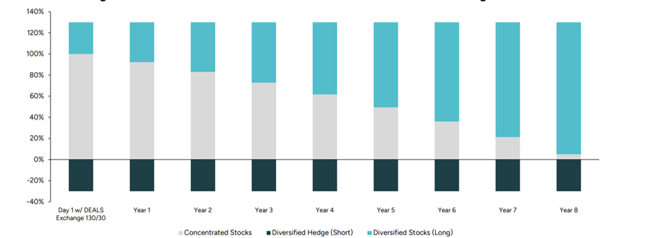
For illustrative purposes only. This chart reflects an anonymized and simplified client scenario and does not represent actual performance or guarantee future results. Results will vary based on individual circumstances, market conditions, and tax considerations.

Caprock’s Integrated Plan of Action
Set the framework
Caprock’s main goal was to lower Roger’s concentration risk, though the tax impact of selling his stock made this challenging. Still, taxes could not be the only factor guiding the decisions. Although this step does not eliminate taxes and all investments come with economic risks, it gave Roger flexibility.
Leveraging two decades of experience advising families and investors facing similar challenges, Caprock mapped Roger’s liquidity, areas of concentration, cash-flow needs and tax exposure to define what a diversification roadmap would look like in practice. The plan treated taxes as a constraint to manage, not a reason to delay risk reduction.
Create liquidity without selling
Caprock began by moving some of Roger’s concentrated stock into a separately managed account run by an outside manager specializing in extension portfolios. Those shares served as collateral, which allowed Roger to access cash and begin building a more diverse portfolio without selling right away or facing a large tax bill.
Although this step does not eliminate taxes and all investments come with economic risks, it gave Roger flexibility. Instead of depending solely on real estate distributions or the timing of a stock sale, he had a way to create liquidity while keeping the broader strategy intact.
Manage taxes systematically
Working with the third-party manager, Caprock designed the account to help Roger stay invested in the broader market while creating losses that could be used for tax planning.
Those losses gave Roger more room to sell portions of his concentrated stock over time without letting taxes drive every decision. The goal was not to avoid taxes entirely. It was to reduce concentration in a more thoughtful way while keeping the portfolio tied to Roger’s broader investment plan.
Sell in stages
Caprock and Roger agreed to reduce the concentrated stock position over time instead of forcing one large sale. As losses accumulated inside the strategy, Roger could sell portions of the low-basis stock and use those losses to help offset the gains.
In practice, this allowed Caprock to do two things at once: lower Roger’s reliance on a single stock and limit the tax impact that would normally come with selling appreciated shares.
Redeploy proceeds
As liquidity was created through lending and stock sales, Caprock built a complementary portfolio across public credit, private credit and select alternative investments. This created a liquid, income-producing part of Roger’s portfolio that could support his lifestyle and offer more flexibility.
The proceeds also helped Roger move toward a more balanced structure, with private real estate, a smaller managed public equity position and a diversified liquid portfolio working together.
Report and monitor
Clear communication was just as important as execution. Caprock established reporting that tracked concentration, liquidity, realized gains and losses, available tax offsets and progress toward diversification. Caprock also set clear rules for the plan. If the stock price moved sharply up or down, the team could accelerate sales, even if that meant paying some taxes. Managing risk remained the top priority.
How the Tax-Aware Diversification Process Works
| Step | What it Means |
|---|---|
| 1. Set up the SMA and move the concentrated position | Caprock moved Roger’s low-basis stock into a dedicated taxable SMA managed by an outside firm with expertise in tax-aware long-short strategies. Roger did not sell the stock at this stage. He retained ownership of the shares, including voting rights where applicable. |
| 2. Use the stock as collateral | The appreciated shares served as collateral, allowing the manager to borrow against the position and build a broader portfolio around it without triggering an immediate tax bill. Borrowing was kept conservative, with the final level based on the stock’s volatility and the manager’s guidelines. |
| 3. Build the long-short extension | The manager added long and short positions around the concentrated stock, using Russell 1000 stocks to maintain broad market exposure and manage risk. This expanded the number of holdings available for tax-loss harvesting, which was critical because Roger’s original stock had a low-cost basis. |
| 4. Harvest losses inside the strategy | The manager monitored the long and short positions and realized losses when opportunities appeared. Those losses became the tax engine of the strategy, helping offset gains from Roger’s planned stock sales. |
| 5. Sell the concentrated stock in stages | As losses accumulated, Roger sold portions of the low-basis stock over time. The proceeds could reduce portfolio borrowing or move into more diversified holdings, allowing Roger to lower concentration risk gradually. |
| 6. Manage and adjust the account over time | The manager continued to rebalance the account, monitor borrowing levels and keep the portfolio aligned with the Russell 1000. Caprock and Roger reviewed margin levels, risk, gains and losses, and progress toward diversification. |
Summary of the Outcome
Tax result: Losses generated inside the SMA helped offset gains from selling the concentrated stock.
Risk and return profile: Roger kept broad market exposure while gradually reducing his reliance on a single public stock.
- ~15% reduction in concentrated stock position in year one*
- ~$600,000 in capital gains taxes mitigated through realized losses**
- A new liquid, income-producing portfolio sleeve established
- Improved flexibility for future private market and estate planning decisions
*Based on starting position size of 323,000 shares on 4/9/25 and an ending position size of 277,215 shares on 12/31/25 reflecting actual shares. **Based on $0.02 / share cost basis, offset $600k Capital Gains, period of 04/09/2025 – 12/31/25, reflects estimated tax payment.
Fast Forward
Today, Roger’s balance sheet is organized around three pillars: private real estate, a smaller managed public equity position and a diversified portfolio designed for liquidity, income and differentiated exposures. Instead of depending so heavily on real estate distributions or stock-price moves, Roger now has meaningful access to liquid, income-producing assets.
Over the next six to eight years, the plan is to continue reducing the concentration while maintaining an appropriately sized long-term allocation. With liquidity and diversification improving, Roger and his family can also evaluate longer-term planning, including estate decisions that rest on a more stable foundation.
Key Takeaways
- Concentrated wealth can limit flexibility even when net worth is high
- Low-basis stock often creates a tax hurdle that complicates diversification
- Liquidity can sometimes be created before a full sale through a collateralized strategy
- Tax-aware portfolio design may help offset gains while reducing single-stock exposure
- Diversification works best when taxes, liquidity, and long-term asset allocation are addressed together
Contact Caprock for a personalized, no-obligation consultation.
This case study is based on a current Caprock client, but the name has been changed to protect their identity and maintain confidentiality. The client was not compensated in any form. While every effort has been made to accurately portray the details of the case, certain elements may have been modified or excluded to further safeguard the privacy of the individual. This case study is intended for informational purposes only and should not be seen as a substitute for professional financial advice. The results and outcomes described in this document are specific to the individual client and may not be applicable to all situations. This case study is intended to provide general information about Caprock and is not a solicitation or offer to sell investment advisory services except in states where we are registered or where an exemption or exclusion from such registration exists. ©Caprock. The Caprock Group, LLC (Caprock) is an SEC Registered Investment Advisor. Registration with the SEC does not imply a certain level of skill or training.