
Executive Summary
When John came to Caprock, he wanted his capital to help generate a positive social and environmental impact. However, he didn’t know where to start. While John was financially savvy, he lacked experience overseeing an extensive investment portfolio and wanted guidance on how to make a real-world impact. John’s previous experience with financial advisors was unproductive and lacked a deliberate value investing approach.
Impact investing provided a potential solution. John was interested in the approach, but still had questions about how impact investing worked, how it differed from ESG, and how it could be implemented without compromising returns.
Caprock addressed his concerns by helping John refine his values, construct a portfolio, and carefully select a set of highly qualified impact managers. As a result, he was able to establish a scalable portfolio in which impact investments would eventually account for 20–25% of assets over time.
At a Glance
- High-net-worth individual
- Familiar with financial advisory services, but frustrated by previous experience
- Interested in aligning his portfolio with positive change to establish a meaningful relationship with his investments
- Seeking impact investment opportunities without compromising returns
Goals and Objectives
- An investment strategy that aligns with core values and long-term vision
- Measurable social and environmental impact investments while meeting return and cash flow goals
- A foundational understanding of impact investing to support informed decision-making
- A roadmap to scale impact allocation to 20% to 25% of the portfolio over the next decade

Caprock’s Integrated Plan of Action
Defining Impact Priorities Using Structured Discovery
Caprock began by establishing a personalized framework for John to start investing capital into themes related to his stated values, such as the environment and helping small businesses. Based on this framework, Caprock designed an initial portfolio that matched those priorities along with his financial goals.
To better understand John’s mission and values, Caprock held several discovery meetings and conducted a values-mapping exercise to identify which priority themes resonated most strongly with him. Rather than producing a ranked list, the exercise focused on the relationships between John’s interests and how they connected to diverse themes. He wanted to maintain a balance across themes while continuing to explore options reflecting his values over time.
John wanted to help reduce climate harm, support aquaculture, improve food access in underserved communities, and expand access to capital for small, values-aligned businesses. Based on these insights, Caprock created a roadmap for impact allocations in the portfolio.
Impact Investing 101
Since John was new to impact investing, Caprock sought to educate him on what the process entails and clarify many of the common misconceptions.
For example, people often assume that impact investing requires a sacrifice of returns. While such strategies exist, Caprock emphasized:
“concessionary performance” is a choice rather than a defining feature of impact investing.
All strategies were designed to offer competitive, market-rate, risk-adjusted financial returns alongside measurable impact outcomes.
Caprock clarified the distinction between ESG and impact investing using a practical, portfolio-construction lens. Impact investing targets the products, services, and solutions companies provide. ESG describes how companies operate and is primarily focused on public markets.
Caprock helped John identify additional interests, including education, healthcare, financial inclusion, and community development. The firm emphasized meeting him where he was and supporting appropriate engagement. Impact investing exists on a spectrum and didn’t have to be an “all-in” commitment for John.
Finally, Caprock stressed accountability. The firm provides a robust impact reporting platform so managers can clearly and consistently measure impact outcomes annually.
Selecting the Right Impact Managers
Caprock then curated a pipeline of impact managers from its integrated platform that aligned with John’s priorities. The firm’s dedicated investment team uses a thorough evaluation process. When vetting impact funds, they bring the same financial rigor, discipline and process as used in traditional manager selection. On top of that, there is an added layer of diligence that evaluates the fund’s impact measure and management, impact thesis, and intentionality.
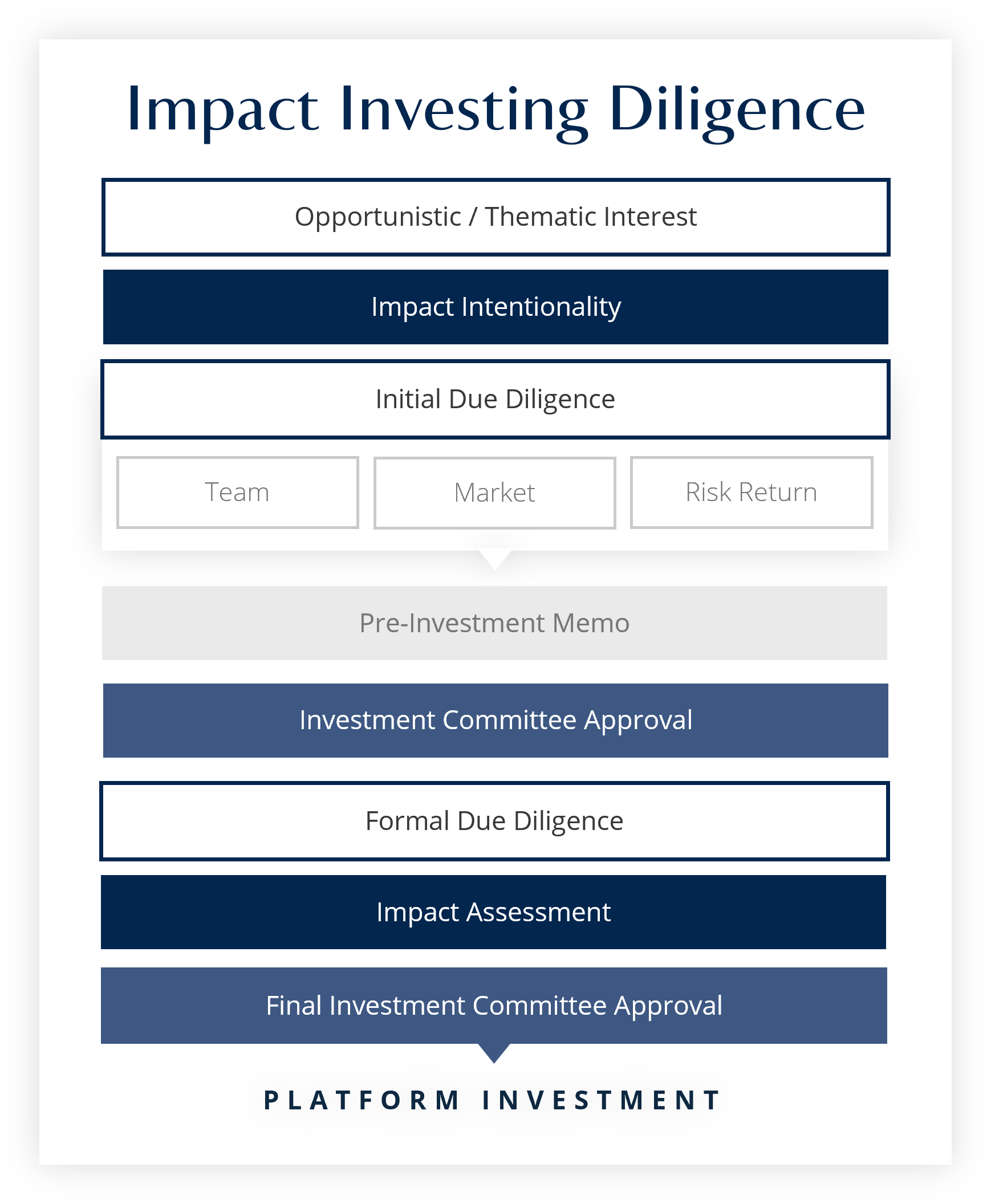
Managers need to ensure that John’s investments have a defensible impact thesis that can be measured to meet John’s goals.
Deploying Capital with Pacing, Oversight, and Intent
John was enthusiastic from the start and didn’t require any cash balance at the outset. So Caprock recommended investing in less liquid opportunities in private markets, which can include assets like private equity, private debt, venture capital, and real estate. The firm worked hard to make sure John’s portfolio was sufficiently diversified and consistent with his values. Initial impact investments included affordable housing, financial inclusion, and energy decarbonization themes. Caprock leveraged its reporting platform to track the fund’s financial performance and impact metrics.
Because private market investments take time to deploy capital, Caprock faced the challenge of measuring outcomes from the start. The firm focused on helping John manage his expectations until more robust data could be collected.
Fast Forward
Within the first 18 months, John transformed himself into a confident, disciplined impact investor. His team at Caprock holds regular check-ins to review the portfolio and ensure it continues to reflect his priorities as they evolve.
His portfolio continues to meet his expectations and includes a solid pipeline of private investment opportunities aligned with his impact thesis. It reflects his desired amount of risk and liquidity requirements and expectations for returns.
Impact Indicators and Long-Term Potential Performance in line with relevant benchmarks
- Preservation of liquidity and cash flow generation
- Strong early indicators, including disciplined deployment pacing, portfolio companies meeting operational milestones, and select follow-on rounds resulting in early markups
- Initial impact metrics reflect strong alignment between portfolio company activities and stated impact objectives
Current Metrics (First 18 Months)
$2.3 million in capital extended to underserved borrowers
129,000 jobs supported
Future Potential Metrics
- Affordable housing units financed
- Tons of greenhouse gas emissions mitigated
- Underserved individuals provided access to healthcare
Today, John views impact investing not as a separate allocation but as an integrated part of a long-term wealth strategy. He has a clear roadmap and thesis, and he receives ongoing support through his partnership with Caprock.
Caprock partners with families and entrepreneurs to bring clarity, discipline, and purpose to complex investment decisions.
Contact a Caprock advisor to start a values-mapping conversation.
*This case study is based on a current Caprock client, but the names have been changed to protect their identity and maintain confidentiality. The client was not compensated in any form. While every effort has been made to accurately portray the details of the case, certain elements may have been modified or excluded to further safeguard the privacy of the individual. This case study is intended for informational purposes only and should not be seen as a substitute for professional financial advice. The results and outcomes described in this document are specific to the individual client and may not be applicable to all situations. This case study is intended to provide general information about Caprock and is not a solicitation or offer to sell investment advisory services except in states where we are registered or where an exemption or exclusion from such registration exists.
©Caprock. The Caprock Group, LLC (“Caprock”) is an SEC Registered Investment Advisor. Registration with the SEC does not imply a certain level of skill or training.